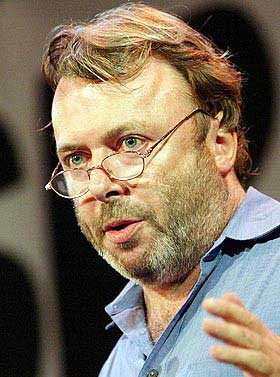
Christopher Hitchens is at it again. Weighing in at Slate Magazine (here) about his own "eureka moment" (his description) regarding evolution that has further ensconced his inability to "grasp the gross stupidity of those who repose their faith in divine providence and godly design"
It is amazing to me that a man of his intellectual aptitude and interest in this specific topic would describe his brand new revelation as a eureka moment and scurry off to inform us all about it.
For starters, the blind salamander (Eurycea (Typhlomolge) rathbuni) was placed on the endangered species list in 1967. That's right, Christopher Hitchens' "eureka moment" stems from a discovery that is at least 41 year-old news. I understand the definition of a "eureka moment," but if Hitchens is as smart and motivated as he claims be about proving the gross stupidity of those of us who believe the design argument, it seems that he would have considered this old news long before now. Of course, that observation has nothing to do with his claim -- I just find it interesting.
Second, Hitchens acts as if the stupid creationists deny evolution takes place, and that they would also defend the idea that an all-powerful God would create a blind salamander. But that is not what any creationist is saying!
I honestly do not know a single creationist who denies that adaptation (which would be defined as micro-evolution) takes place within species. But, once again blurring the definition of "evolution" to make his case, Hitchens wants us to accept that obvious fact as proof that salamanders can, and do, change via such adaptations into something other than salamanders.
How?
Where is the evidence for that claim?
Third, the more substantial problem that Hitchens is blind to (pun intended) is the inability for a purely materialistic explanation to account for the incredibly high information content that exists in the DNA of even the simplest living things. We have no other example anywhere in the world where blind, undirected processes create new information. And that is the real point that Hitchens seems to miss.
It is not just the existence of information -- it is the claim that evolution is capable of adding information to the DNA of living systems that is in question. For a seeing salamander to evolve into a sightless salamander entails a loss of information in the salamander's DNA. No one disputes that such a thing could happen. In fact, the second law of thermodynamics demands that this be the case.
What Hitchens must explain is the evolution of sightless salamanders (or anything else) into seeing salamanders (or anything else) -- a process that entails the addition of information to the DNA of the system and therefore defies the second law of thermodynamics. That is the question that Christopher Hitchens needs to recognize as being worthy of constituting a "eureka moment."
One thing you can say about Hitchens is that he is most definitely not stupid. That being the case, there must be some explanation for his missing such elementary concepts as these. If we know that he is intellectually capable of grasping the importance of these questions, the only explanation is that he refuses to consider the answers to them before he goes about asking.
Or, to put it another way, none are so blind as those who will not see.


 Apples to Oranges
 "The true gentleman is the man whose conduct proceeds from good will and an acute sense of propriety, and whose self control is equal to all emergencies; who does not make the poor man conscious of his poverty, the obscure man of his obscurity, or any man of his inferiority or deformity; who is himself humbled if necessity compels him to humble another; who does not flatter wealth, cringe before power, or boast of his own possessions or achievements; who speaks with frankness but always with sincerity and sympathy; whose deed follows his word; who thinks of the rights and feelings of others, rather than his own; and who appears well in any company, a man with whom honor is sacred and virtue safe." John Wayland
 Just a quick blurb to point out a couple of recent articles that should cause the naturalistic science folks to have "some 'splainin' to do." These kinds of things pop up every once in a while and it is interesting to consider the explanations they offer for discoveries like these.
 At least they admit it. But what some cosmologists won't admit is the incredible fine-tuning that had to go into the universe just to allow us to exist at all.
  A fascinating story was just forwarded to me from a friend that I think deserves some comment and consideration. Today's