Sunday, October 22, 2006

Immaculate Deception

The AP news flash on my ISP homepage caught my eye yesterday:

"Melissa Etheridge, Partner Have Twins."

LOS ANGELES (AP) — Melissa Etheridge and her partner, Tammy Lynn Michaels, are the new parents of twins, the couple announced Friday. Michaels gave birth to a boy and girl Tuesday: son Miller Steven and daughter Johnnie Rose.

Knowing that Etheridge is a lesbian, the wording of the piece is bizarre. Was this some kind of miraculous conception ... two women have somehow found a way to become "the new parents of twins"? A quick look at Etheridge's website didn't help.

"Tammy and the babies are in excellent health," Etheridge said ... "The creation of life brings about immeasurable love, and pours hope into the future. The joy will help carry us through our upcoming sleepless nights," the couple said in a statement.

In my (albeit horribly out-of-date) 1977 vintage dictionary, a "parent" is defined specifically as "one who begets or brings forth offspring; to ORIGINATE, PRODUCE." Apparently things have changed since 1977. Way back then, you probably would not have imagined a description of the the "couple" like this one either:

Etheridge, 45, and Michaels, 31, held a commitment ceremony in 2003. The
Grammy-winning singer has two children from her relationship with former partner
Julie Cypher: daughter Bailey Jean and son Beckett.

Way back then, your average person understood a "couple" to be a man and a woman, boy and girl. There was no such thing as a "commitment ceremony," and everone would have assumed that describing someone as "having two children from a previous relationship" would entail the death or divorce of either the man or the woman who was the parent of those children.

Not so in the modern, enlightened, progressive present.

I must admit that buried deep in the story was the fact that all the proud couples' children were the result of sperm donations. But the headline and gist of the story was, either consciously or unconsciously, meant to portray the lesbian relationship of the proud "parents" as perfectly normal. It was meant to cast the artificially-produced children in this "family" as being the offspring of their natural parents.

Those who influence our culture are shrewd and deceptive in their efforts to pass off the aberrant, unnatural corruptions of our God-given humanity as being perfectly normal. It has been that way for thousands of years (Read Romans 1) and it will continue to be that way for those who choose to condone such actions.

I don't.

The hope is that, hearing about such perversity long enough will numb us to it; make it seem that "that's just the way things are now," and eventually wear us down enough that we will accept it.

I won't.

As a follower of Christ, I will love these women and their children. I will pray for them each to come to know the Truth. I will treat them with kindness and respect. I will attempt to help them see the difference between parents and caretakers. But bad ideas are just bad ideas ... no matter how new or old your dictionary happens to be. Corruption of the creation is what it is ... and what it is, is something we should never condone ... no matter how "intolerant" we are accused of being for doing so.

Tuesday, October 10, 2006

Pushing Strings

While some skeptical scientists have had the temerity to question the speculative “Science of the Gaps” inherent in Superstring Theory and its Multiple Universe progeny, they have not abandoned the notion of a GUT. The August, 2006 issue of Scientific American reports that Alain Connes of the Collège of France in Paris, wants to expel Rube Goldberg from the discussion altogether. In place of the physical reconciliation of the macro/micro paradoxes of general relativity and quantum mechanics, Connes’ proposes a mathematical solution. By use of what he calls “noncommutative geometry,” Connes aims to replace the Cartesian definition of space with an altered geometry that recognizes the peculiarities of quantum theory and the spacetime implications of general relativity.

Unlike its Superstring predecessor, Connes’ mathematical model removes the requirement for actual infinities that have dogged its Superstring alternatives. Where “[Super]string theory cannot be tested directly … noncommutative geometry makes testable predictions.” According to Connes, his approach not only better “reflects reality,” it allows physicists to “peer into the complexity” of physics to reveal the “hidden jewels” behind it.

The physics and mathematics behind both Superstring Theory and noncommutative geometry are literally beyond the ability of most of us to comprehend. Superstring Theory may be headed for the ash heap of history. Connes’ new geometry may be its replacement. Time will tell. But the implications of each are the same.

The existence and emergence of the entire ensemble of forces and particles that comprise our universe does not in itself explain the synergy with which the different components of the system operate. This nature, a nature described so well by the language of GUT mathematics, is, says Max Tegmark in the same article noted above, “an abstract, immutable entity existing outside space and time” that allows for the orderliness and invariant properties we observe in nature. It is “something bordering on the mysterious” that has “an eerily real feel” to it and satisfies “a central criterion of objective existence.” Stephen Hawking asks where such characteristics as mathematics, and the laws of physics and chemistry, could have originated. Even the supreme atheist Bertrand Russell once remarked that mathematics holds both truth and supreme beauty.

The astounding implications of these cosmological theories have driven naturalistic scientists to infinite ends in their many and varied attempts to explain them away. But they are not going away. Theories come and go but the implications of those theories remain steadfastly in place.

Monday, October 09, 2006

All Strung Out

Theoretical physics has confirmed agreement between the predictions of General Relativity Theory and its correlation to the physical world to within a trillionth of a percent precision – a precision that cannot be written off to chance. On the macro-scale, where general relativity predominates, this makes nature quite predictable. It also offers implications, the most profound of which is the suggestion that the universe must have had its beginning in a “singularity” of infinite density where all matter, energy, space and time were condensed.

At the same time, Quantum Mechanics has proven to be an extremely fruitful scientific discipline for predicting and understanding the micro-level workings of our universe. At the quantum level, indeterminacy reigns. But the probabilities describing unpredictable events succeed in some way to end in a predictable array of outcomes. Quantum mechanics offers its own view of the origins of the universe that also includes issues regarding the singularity. General relativity and quantum mechanics do well at describing their separate realms but they do not seem to be compatible with one another.

For many years the search has been on for some way of quantifying and describing this micro-level/macro-level paradox. Science believes the answers lay in some kind of Grand Unified Theory (GUT) that is capable of offering an integrated view for how the universe operates in its current fashion, and to understand the singularity from which it appears the entire universe emanated. The most promising version of a GUT, which first emerged in the late '70s, has been Superstring Theory, a theory that explains all the known forces and observed particles as having been produced by vibrations in tiny “loops of energy” called strings.

The theory is esoteric but the most comprehensive form of it requires the universe to have originated in ten dimensions, six of which quickly “rolled up” into a compact, invisible coil that exists everywhere within the four observable dimensions. Physicist Hugh Ross summarizes Superstring Theory as follows:
"It is the only theory that self-consistently explains all the known
properties of the known fundamental particles (now numbering 58), all the
properties and principles of quantum mechanics, all the properties and
principles of both special and general relativity, the operation of all four
forces of physics, and all the known details of the creation event."
Sounds like a winner ... or at least it did. Recently, doubters (and there have always been some) have become more vocal about the fact that they believe Supersrting Theory may be unraveling. Critics claim that Supersting Theory has become "a Rube Goldberg contraption" in its most recent, complex iterations. Interestingly, the reason for their skepticism lies in the fact that, to reconcile the complex implications of the theory, naturalistic scientists have been driven to postulate that an infinite number of universes exist and that they are all different . We just happen to be in the one that has all the parameters just right to allow for life to exist.

Notice that the theory, put forth by a plethora of scientists who demand that all scientific proposals must be empirically measurable and falsifiable, proposes a solution (an infinite number of external and therefore undetectable universes) that is both unverifiable and unobservable.

The hypothesis originally devised by Princeton graduate student Hugh Everett was at one time described as an “outrageous” interpretation of quantum mechanics because, as Nancy Pearcey and Charles Thaxton explain in their 1994 book, The Soul of Science, “…the idea of innumerable, unobservable universes co-existing alongside the one we see at any instant is too extravagant to be widely accept.”

More recently however, in the cover story for the May, 2003 issue of Scientific American titled, “Infinite Earths in Parallel Universes Really Exist,” physicist and astronomer Max Tegmark stated that, "The idea … seems strange and implausible, but it looks as if we will just have to live with it, because it is supported by astronomical observations."

Whoa!

Let's think about that one for a second. Notice that Superstring Theory does not attempt to explain the level of complexity (design?) that exists in our universe. It recognizes these astronomical observations and accepst them. Then, in order to impose a naturalistic explanation for this complexity on those observations, the existence of an infinite number other universes has been inferred.

In other words, naturalistic scientists have unwittingly admitted that the complexity exhibited by our universe can only be explained as having emanated from a potentially infinite source.

Now isn't that interesting? And isn't it also interesting that some skeptical scientists have actually exhibited some backbone by questioning such an explanation. Don't get me wrong. I'm no physicist and could not begin to explain the details of Superstring Theory to anyone. I don't know if Superstring theory is flawed or just in a slump. But I can recognize its implications.

And in this case, the implications are Divine.

Monday, October 02, 2006

Who's Afraid of the Big Bad Bang?! (Part II)

It would take a larger space than I have (or could fill for that matter) to chronicle the many views of the universe's origins that have existed through history. Suffice it to say that, because there was no scientific way to analyze or verify any of them, they stood as philosophical speculations. Plato thought that experimental science was unworthy of the attention of great intellects (like himself). Aristotle, Plato's student, thought it self-evidentially obvious that the Earth could not move because it had already found its way to the center of the universe.

Newton, who tried to apply scientific evidence to the issue, determined that gravity, because it entails the attraction of all particles toward one another, would have caused the edges of the universe to collapse toward the center. Because this obviously was not going on the universe could not be finite. He therefore deduced that the universe must be infinitely large and matter evenly distributed within it. In the mid 18th century Kant's cosmology added that, for various reasons, the universe had to have no beginning in time and be infinite in extent.

For a couple of centuries there were no scientific cosmological developments that could unseat these dogmatic views. So, as Hugh Ross points out in The Fingerprint of God, Newton's static, eternal, infinite universe was "cast in concrete" and readily accepted by all thinking people, most notably those who saw this fact as removing any need for a cosmological First Cause -- or what some of us might call, "God."

That's when Einstein came along and upset the apple cart. Struggling to put forth a theory to explain gravity, Einstein published his Theory of General Relativity in 1915. Part of his struggle was with the rascally, inconvenient implication his equations kept bringing up. No matter how many times he recalculated things, he continued to be bothered by the fact that, if he was correct, the universe had to be expanding. Scientific dogma disallowed such an implication so, in an effort to maintain professional respectability, Einstein inserted a cosmological constant into his equations to cancel out the expansion.

The key point in all this is that Einstein (and others) rejected the idea of an expanding universe not for scientific reasons, but for philosophical reasons! You see, if the universe is expanding as time goes on, running the clock backward tells us that, at some point (now referred to as the "singularity"), the universe must have begun to expand from a single point -- the point at which a universe-sized Cause must have set the expansion in motion.

Einstein's theory had divine implications.

By 1929, Edwin Hubble published his finding that, not only was the universe around us expanding in every direction, but the farther out he looked, the faster it was expanding. This data fit perfectly with Einstein's equations and forced him (Einstein) to admit that his cosmological constant was uncalled for. He later described his insistence on including it the "biggest mistake of his life."

The upshot of all this is to point out that atheist scientists hate the idea of the Big Bang, not for scientific reasons, but for philosophical ones! Sir Arthur Eddington called the idea that the universe had a beginning "repugnant." Fred Hoyle was prompted to sarcasm and was the originator of the term "Big Bang." Hoyle meant the name to be a derogatory label for a concept he could not bring himself to stomach. The problem is that today, scientists have verified the accuracy of the Big Bang so extensively that many refer to it as a “law” instead of a theory. Christian Theists need to realize that the Big Bang is not something we should fear.

Cosmologically and scientifically speaking, The Big Bang may be our greatest ally.

Friday, September 29, 2006

Who's Afraid of the Big Bad Bang?! (Part I)

It is interesting to me how negatively many folks view the Big Bang theory for the origin of the universe. There are two groups of people in particular who fiercely resist accepting it – but for completely different reasons. Today I will address the first group – Young Earth Creationists.

Many Christians are violently opposed to the idea of the Big Bang for one or both of the following reasons:

First, they believe that the Big Bang is a ploy, perpetuated by those who worship at the altar of scientific divinity, to promote the idea that the universe is old enough to allow time for Darwinian evolution to explain life on Earth. While many naturalistic scientists do promote this notion, the fact is that time is not what the evolutionists need. What they need is vastly more unattainable than a whole lot of time. They can have all the time they want. What they need is the ability to account for multiple reversals of, or the ability to completely dispense with, the 2nd Law of Thermodynamics. Darwinian evolution simply cannot account for the self-organization that would have to occur to allow life to “emerge” from non-life.

Complex biological life demands explicit instructions and information content that cannot be brought about by random, chance events. As Dean Overman points out in his excellent Case Against Accident and Self-Organization:

“Because there are thousands of different enzymes with different functions, to produce the simplest living cell [requires] that about 2000 enzymes were needed with each one performing a specific task to form a single bacterium like E. coli. Computing the probability of all these different enzymes forming in one place at one time to produce a single bacterium [it has been calculated] that the odds are 1 in 10 to 40,000th power … The total number of atoms in the observable universe are estimated to be only approximately 10 to the 80th power.”

It is not the case that the amount of time normally understood to have elapsed since the Big Bang (about 14 Billion years) is sufficient to overcome these odds. In fact, no amount of time is sufficient to turn an entropy-increasing universe like the one in which we exist into the kind of entropy-reversing universe needed allow for this kind of self-organization to occur.

Secondly, they believe that the Big Bang describes a catastrophic, chaotic, out-of-control “explosion” that could not have originated with a perfect God. But the idea that the Big Bang was chaotic is just plain false.

Rapid, yes. Chaotic, no.

The level of order and complexity that had to have existed within the Big Bang singularity is nearly (if not actually) infinite. All four forces of nature (gravity, electromagnetism, weak and strong nuclear forces) have been experimentally verified to be in place within 10 to the minus 11th seconds after the creation event. Quarks, the building block particles of protons and neutrons, showed up 0.00000000001 seconds later. The characteristics (strength, weight etc.) of each of these (and many more) had to have been exquisitely fine tuned to allow for life to ever be possible.

In short, the Big Bang was not a random explosion. It was the superbly ordered, delicately engineered product of the Divine Mind. If Christian Theists were to imagine the kind of event that that would result when “In the beginning, God created …” it is exactly the kind of thing they might picture.

To accept the pejorative description of the Creation Event as being otherwise is to buy into the atheistic sarcasm of the guy – Fred Hoyle – who gave the Big Bang its name. Next I’ll look at why he did so and hopefully give Young Earth Christians a reason to consider why they share a fear of the Big Bang with atheistic scientists. While I understand, and share, the motivation of Young Earthers to honor Scriptural authority and vehemently oppose any attempt to deny God’s hand in the creation, I believe they need to consider the concept of Dual Revelation more seriously where the origin of the universe is concerned.

Monday, September 25, 2006

Empty Space

“Call it a hobby. Call it an obsession. Call it the new way of socializing in the networked world … Call it “friending,” the way millions of teens and young adults obsessed with social networking sites such as MySpace and Facebook are making connections … Friendship always has been a tricky game, especially for teens. But in the past it was played out in school hallways, on playgrounds and in late-night phone calls. … These days it is happening in full color on the computer screen … “

On-line “relationships” are trendy these days. MySpace is the place to be – so much so that, according to psychologist Susan Lipkins, teenagers now judge their social status by the number of “friends” they can claim on their buddy lists. Those with short lists are considered social rejects and suffer with self-esteem issues because they are judged by the number of friends they can collect.

The news media focuses on the dangerous perversions that have arisen from such social networks. In fact, the same issue of USA Today in which the article quoted above appeared also contained the story of former Department of Homeland Security higher-up who used his online access to send pornographic pictures of himself and brag about his high-powered government position, in an attempt to arrange an illicit liaison with a 14-year old girl.

No doubt the anonymous nature of these social networks can be dangerous – but why? Why does anonymity lead to perversion and trouble?

I would contend that the root of the problem lies in the fact that, while an on-line relationship may be a “fun” way to share information and even discuss shared interests, it is not really a “relationship” at all. At its root, it is not based in ultimate reality because it condones the absence a crucial aspect of what constitutes our humanity -- the social context.

Sharing information is not all there is to a relationship. Modern technology allows us to view information with stunning detail and an authoritative presentation that implies credibility where there may be none – and interpersonal communication where none really exists. The ubiquity of such information, and effortless access to it, has shrunk our world to the point that we can “experience” nearly anything we desire without ever leaving our desk.

We can: shop for supplies, sell our possessions, buy products that arrive at our doorsteps within hours, contribute to charitable causes, earn college diplomas, carry on conversations stripped of body language, make “friends,” destroy our marriages and families by falling in love and arranging sexual liaisons; all without any form of actual human contact. This ability is not just unique to our time, and not just possible because of technology, it is a capacity that would never have been conceivable without it. And it is completely antithetical to the Biblical concept of a properly functioning human person.

Within the doctrine of the Trinity, and as consummated on the day Adam received his helper, the social dimension of the person is unique to our design. Yet the Internet allows us to bypass it at our will. Anonymity not only shuns accountability, it permits both an unchecked retreat into the dark corners of the corrupted human self, and the denial of reality concerning personhood. The Internet cannot be solely blamed for the tendency of man to withdraw into himself, but it is a devastatingly proficient modern vehicle for accelerating that inclination. Marriages, families and congregations of believers all suffer from the damaging effects of a technology driven mindset that cultivates an injured and isolated human soul.

Friday, September 22, 2006

Larry Bird, R.I.P.

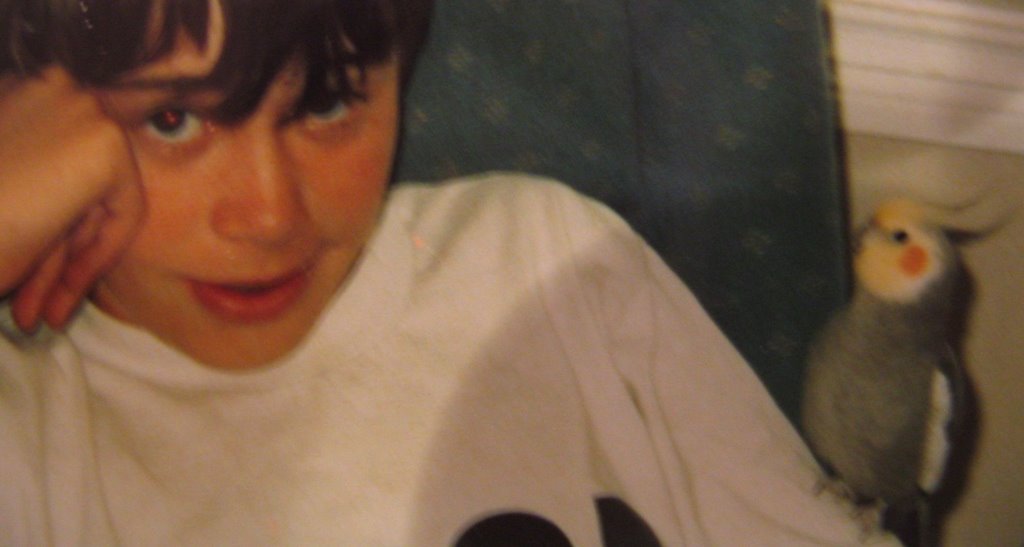
We just buried our family’s pet cockatiel, Larry. He was not an extraordinarily bright or talented bird – he thought he had a twin brother who matched his every dance move when he stood in front of a mirror or even in front of the shiny faucet of our kitchen sink. But he could whistle approvingly at you when you walked into a room, or offer his rendition of “Take Me Out To The Ballgame” 716 times in a row while you were trying to watch a television show. He could hiss at you when you tried to take him out of his cage at a time when he preferred to be taking a nap, or try to peck holes in your fingers when you tried to put him back in. He spent many a day alone and ignored in his 2’ by 3’ birdcage. Larry was a hit attraction four years ago when he first graced our family room on Christmas morning. He was well taken care of. But Larry had long since lost his status as the center of attention and popularity at the Perry house.

And that’s why I was surprised at the outpouring of grief and volume of tears that flowed following his unexpected death a few days ago. My boys – two of which are tough-guy, too-cool (by that I mean “typical”) teenagers – were devastated when the found Larry lying lifeless in the bottom of his cage. Their sobbing returned when we buried him in the backyard the next day.

Why would a silly, annoyingly loud, exceptionally messy little bird bring about such a reaction from the boys for whom Larry’s novelty had long worn off?

Larry also spent many an hour rubbing his fuzzy head on my son’s neck while getting his own neck massaged gently with a loving finger. Beside his piercingly shrill whistle, he could also chirp and coo you to sleep. He longed for attention and was quick to return it to the son with whom he bonded as a baby bird.

Larry had no creative will – we built the ladder he used every day to clamber around in his cage. He exhibited no moral awareness – he would just as soon take your eye out with his beak or steal the earring out of my wife’s ear. He had no thirst for knowledge – it took untold hours and treats to coax him into that “Take Me Out To The Ballgame” rendition that he would never have conceived of on his own. He had no appreciation of beauty – even of his own.

But despite all the differences he exhibited between we spiritually imbued humans who are made in God’s image, Larry was nonetheless a living creature, created by a loving God, and possessing some form of a soul. We can never explain the full extent of what constitutes the substance of life in any form but somehow we recognize its worth. In some way we are aware of the beauty and precious nature of that life because, whether we knowingly embrace it or not, it is built into the fabric of the universe. When a life to which we are emotionally attached comes to an end, that fabric is marred and the blemish touches our own soul.

In that way we recognize that Larry shared our dependence on the Creator, and our value as an object of His loving purpose for our existence. In that way we can connect to an annoying little bird because we somehow share the gift of life itself with him. This is not to equate the value of human life with the value of a little bird – but it is to acknowledge our commonality in its Source.

We’ll miss you, Larry.

Tuesday, September 19, 2006

Anthropologist: Neanderthals More Normal Than We Are

This is a Neanderthal, and, lest you have any doubt about your status as an inhabitant of planet Earth, anthropologists have confirmed that he is "more normal than you are." Isn't that comforting?

Question: How did these anthropologists determine Mr. Neanderthal's normative status?

Answer: By assuming the validity of certain philosophical presuppostions, conforming their "findings" with those, and then making their philosophical assumptions sound scientific results. This is what is referred to as circular reasoning.

Consider the scientific facts documented by Fazale Rana in his book "Who was Adam?":

  • Nine mitochondrial-DNA studies conducted since 1997 have repeatedly shown that Neanderthal DNA sequences display only a 3.7% variation between specimens. This lack of genetic diversity implies that Neanderthals began as a small population in a specific geographic region.
  • That region (in Germany's Neander valley) is distinct from the widely accepted location of modern human origins in eastern Africa.
  • Repeated studies of human mitochondrial-DNA sequences reveal sharp and consistent genetic differences between Neanderthals and humans.
  • Neanderthal DNA does not show evidence of being modern human DNA which became exitinct. Rather, it reveals the unequivocal trademarks of a seperate species.

Though there is more detailed evidence available in Rana's book, the point is this: For almost 10 years, anthropologists have known that Neanderthals and humans are gentetically unrelated species. Though Neanderthals (and others) may exhibit human-looking traits, looks aren't everything. For claims of common ancestry to be legitimate, the devil is in the genetic details.

In other words, the scientific evidence is clear about the relationship between Neanderthals and humans. Yet those who write the popular literature continue to insist, and encourage others to accept, that we humans are just another branch on the evolutionary ape tree by making statements like these:

"But in terms of evolution of our family tree, the genus Homo, we're the
outliers and the Neanderthals are more toward the core."

Humans are not at the inevitable end of a sequence, Trinkaus said. "It just happens that we happen to be alive today and Neanderthals are not."

Why would these folks insist on inferring linkages that have been proven to be non-existent? Because the naturalistic paradigm requires it to be true. They assume materialist explanations for human origins, then mold their conclusions to the presuppositions with which they begin -- scientific evidence be damned.

Monday, September 18, 2006

What Would Mohammed Do?

In remarks he made last Tuesday when he spoke to professors in Germany, the Pope quoted 14th-century Byzantine emperor Manuel II Paleologus as saying:
“Show me just what Mohammed brought that was new, and there you will find things only evil and inhuman, such as his command to spread by the sword the faith he preached, Benedict quoted.”
Muslim leaders were quick to attribute the 14th Century quote to Pope Benedict himself and thus fuel an incensed and irate reaction from around the Muslim world. Italian police were forced to raise the alert level at the Vatican as a result.

In Basra, Iraq, an indignant al Qaeda linked militant group vowed a war against the “worshippers of the cross” in response to the pope's speech (as if the war this group called for was not already underway). In defiance of the Pope’s outrageous claim – which suggested that the “evil and inhuman way” of Mohammed was to “spread his faith by the sword,” – these Muslim leaders showed the extent of their disgust for such an idea by issuing the following statement:

“We tell the worshipper of the cross (the Pope) that you and the West will be defeated, as is the case in Iraq, Afghanistan, Chechnya,” said an Internet statement by the Mujahideen Shura Council, an umbrella group led by Iraq's branch of al Qaeda, according to the Reuters news agency."

“We shall break the cross and spill the wine. ... God will (help) Muslims to conquer Rome. ... God enable us to slit their throats, and make their money and descendants the bounty of the mujahideen.”

… a statement that might be summarized to say, “we will use evil and inhuman ways to spread our faith by the sword.”

As a follower of Christ, who is repeatedly forced to explain and defend the Crusades, the witch trials, and the Inquisition to those who bash the Christian faith for its hateful intolerance, let me say that I do not defend any of those things. Nor do I deny their historicity.

What I do point out, however, is that each of these was a corruption of the teachings of Christ. They each involved sinful human actions that in no way represent what Christ taught. They are a bastardization of Christianity.

Conversely, the Muslim clerics quoted here, who vow to “slit our throats, break our cross, and spill our wine,” are expressing the unequivocal religious philosophy of their prophet Mohammed whom I quote from the Koran:

Surah 2.191: And kill them wherever you find them, and drive them out from whence they drove you out, and persecution is severer than slaughter, and do not fight with them at the Sacred Mosque until they fight with you in it, but if they do fight you, then slay them; such is the recompense of the unbelievers
It is a fact that many Muslim believers denounce the tactics of these militant groups. They should be applauded for doing so. But when we ask, “What would Mohammed do?” the answer is clear, not only from his writings, but from his actions. The clerics of Basra, and their terrorist minions, are committed to spreading the word by the sword – just as their religious mentor taught them. The sooner we admit this, the better off we’ll all be – Muslims, Christians and Jew alike.


Friday, September 15, 2006

Lying to Themselves

To follow on from yesterday, the journal Discover reports on the work of:
“researchers [who] wanted to see whether brain scans can even pick up a significant difference between brain activity during lying versus when telling the truth.”
First, one is compelled to ask the materialist scientist on what premise this research is based. After all, if the human mind is nothing but a complicated mass of meat which has come to be what it is through an irrational, physical process, why would they expect to detect any physical reaction to such an abstract idea as truth?

There seems to be no reason why unguided evolutionary mutation would in any way connect physical reactions with abstract notions. Yet …
“the brain scans revealed unique areas that only lit up during lying. However, the researchers point out that there isn't one telltale spot in the brain that can automatically indicate a lie. “There really is no one lying center,” Faro says. "There are multiple areas in the brain that activate because there are a lot of processes that have to take place.“
Second, if evolutionary processes could explain a physical reaction to a moral standard of behavior, it would seem logical to assume that that reaction would be centralized to the specific area in which evolution had brought about the divergent speech pattern. There seems to be no reason that this would involve multiple areas of the brain – unless those areas were holistically connected in some way. This, however, is exactly what one would expect to find on the Christian worldview – that moral awareness resides in the soul so that breaching a moral boundary would effect the entire being of the person who did so.

Third, why would researchers care about such a thing? What would cause a scientist to have any notion of what lying is, unless that researcher was aware of an objective standard by which one determines right or wrong – a standard that cannot exist on the naturalistic worldview. The very fact that these scientists are compelled to study such a thing is evidence that objective morality is real and that its effects are inescapable.

Finally, and a little humorously, the research showed that …
“’In the group that lied there were two times the number of areas throughout the brain that showed activation compared with the group that was telling the truth,’ Faro says. ‘That's because to lie, you have to actively suppress memories that are triggered by the question, which takes more effort than simply asserting the truth,’ he says.”
And that …
“One of the most important of these is that the brain has to work much harder to lie than to tell the truth.”
On the naturalistic worldview, there is absolutely no explanation for these findings. The state of the human brain is just the way it is because of a chain of deterministic evolutionary events that brought it to its current form. On this view there is no right or wrong so there should be no impetus for the brain to have to “work harder” to achieve any one outcome rather than another. After all, no one outcome is in any way superior to another.

The only way to make sense of this research, or to understand why the research was even done in the first place, is to accept the fact that the human mind is more than just a clump of gray matter.

Scientists who deny as much are just lying to themselves.