Friday, August 10, 2007

Not A Good Week For The Naturalists

Possible Martian bacteria fossils in a meteorite found in Antarctica. The rock, by keeping its cool, could have sustained life during its travels.


When it comes to comparing the Naturalistic and Theistic worldviews, each has its problems. The theist's biggest one, or at least the one that is most commonly thrown at him, is the problem of evil. "How could it be," it is asked, "that an omnipotent, omni-benevolent God would allow pain and suffering in the world He created." Certainly, this is the most emotionally charged issue facing the Theistic Hypothesis. It is a problem that Christian apologists have been defending themselves against for centuries. But here's the deal. Theistic apologists do two things:

1) They admit there are difficulties posed by the problem of evil and acknowledge it as a legitimate challenge to their worldview that must be addressed.

2) They offer a coherent answer that fits within their worldview and that, even if not accepted, stands as a rational, reasoned answer to the objection.

Not so with the naturalist. It is hard to decide which naturalistic deficiency is the most troubling for them to overcome but for my money I would pick the origin of life. How is it that a purely mechanistic view of the universe can account for the origination (not to mention all the diversity and non-material aspects) of life itself?

Naturalism, though it might acknowledge that the origin of life is a "difficult" issue, fails to admit the extent of the "difficulty" to its view of the world. We are always told that the explanation is forthcoming -- that we just have to wait a little longer to get it. But what we are never given is an admission that the entire subject undermines the very core of naturalism itself. We are most definitely never given a rational, coherent answer to the origin of life problem. The most we get is speculation and then only about theories that are either unverifiable (by definition), serve only to push the argument back indefinitely, or that strangely (and closely) resemble the theistic alternatives we offer ourselves.

Right off the bat, Darwinism doesn't cut it. By definition, Darwinism is a process that picks "winners" from among the variant forms of life. But, before there is any life, there can be no winner and thus nothing from which the much-touted power of Natural Selection can pick. Darwin's ideas about how to overcome this major obstacle have been proven wildly lacking in explanatory power. And in the 150 years since he published Origin of Species, things haven't gotten any better. In fact, origin of life studies have been separated from general evolution because the problems it poses are so overwhelming.

I have addressed this issue briefly in the past so I won't belabor the point here. But one of the favorite naturalistic explanations for the origin of life is panspermia. The "directed" type (aliens put life here as some sort of experimental zoo project) is one of my favorite. For starters, the idea that a transcendent intelligent agent placed life her sounds an awful lot like the Biblical creation account. But if the naturalists insist that the alien they appeal to isn't "god," their theory does nothing but push the origin of life question backward one step. Where and how did the alien life originate?

The "non-directed" variety of panspermia has thus become a favorite among naturalistic scientists. As recently as 2000, some insisted that this version was a legitimate:
One study, reported in the October 27, 2000 issue of the journal Science, shows that a space rock could successfully transport life between planets ... Another group of researchers, reporting in the October 19, 2000 issue of Nature, claims to have found and revived bacteria on Earth that were dormant, in the form of spores, hiding in New Mexican salt crystals for 250 million years. Scientists called the implications of this second discovery profound, suggesting that if further study bears out the findings, it could mean bacterial spores are nearly immortal.
Sounds great. The problem with it popped up this past week in a Rutgers study that blows the whole idea out of the water:

For the first time, there are solid data to refute a popular theory that life came to the Earth aboard a comet, Rutgers researchers said Monday.

Deteriorated DNA from microbes, frozen for millions of years in the Antarctic ice, shows that organisms could not have survived the bombardment of cosmic radiation during deep space travel from outside the solar system, said Paul Falkowski, a Rutgers biologist and oceanographer.

The fact that theistic astronomers and biologists have been making this point for years has gone unnoticed. Remember, their opinion doesn't count because they don't toe the party line by adhering to the "proper" set of presuppositions. That their science is solid and, in this case, reached the same conclusion is irrelevant and goes unreported.

Unfortunately, that's the way the system is set up. But for those of us who follow these issues, this past week was unusually notable. Early on it brought us news from Nature that the commonly accepted notion of human evolution doesn't hold water. Then, later in the week, we find that the optimistic promises of panspermia have been dashed on the rocks of the actual scientific evidence.

No gloating (of course) but let's just say it hasn't been a good week for the Naturalists.

Thursday, August 09, 2007

Pardon Me, But Your Presuppositions Are Showing (again)

I have touched on this subject previously, but this week's report from the Journal Nature casts further doubt on the assumptions surrounding the naturalistic account of human origins. That assumption has been that the evolutionary tree branch on which we homo sapiens live was sprouted from our ancestor homo erectus which, in turn, rose from the earlier ancestor, homo habilis. But new evidence confirms that habilis and erectus actually lived "in the same place at the same time for as much as half a million years."

The fact that these two species seem to have been contemporaries is a surprise to anthropologists, say Fred Spoor of University College London and his colleagues, who discovered the hominin fossils seven years ago.

Spoor explains further ...

H. erectus has always been viewed as similar to H. sapiens in both body shape and lifestyle. Spoor points out that the new discovery suggests a family set-up more akin to that of modern gorillas in which dominant males mate with a harem of females ... A similar set up is inferred from fossils of the earliest hominins, such as the australopithecines, but there has been a widespread assumption that sexes of more or less equal sizes arose when our ancestors ditched their more ape-like characteristics, evolving from Australopithecus into the more genteel Homo. "To find such a difference in H. erectus ... was quite a surprise, actually."
Let me be clear. I am not suggesting that theories do not require updating and refinement with the gathering of new evidence. That is what science is all about. But my point in addressing this find is to show that evidence like this does not just serve to "refine" evolutionary anthropology. It does not just suggest that the branches of the evolutionary tree be trimmed or rearranged. These findings suggest that the entire Darwinian Tree model is suspect, further proving the point Phillip Johnson first made in 1991 (Darwin on Trial, p. 50) that "... the outstanding characteristic of the fossil record is the absence of the evidence for evolution."

Darwin's legendary "Tree of Life" suggests that the central, narrow trunk of early life branched gradually into a more and more diverse forms as it grew through time. That is the theory, and the paradigm lens, through which Spoor and his ilk interpret their studies. Now, however -- and here I must acknowledge and applaud Spoor's honest assessment -- the evidence paints quite a different picture:

Overall what it paints for human evolution is a "chaotic kind of looking evolutionary tree rather than this heroic march that you see with the cartoons of an early ancestor evolving into some intermediate and eventually unto us," Spoor said in a phone interview.

This comment bares an eerie resemblance to Jonathan Wells' claim (Icons of Evolution, ch. 3), made 7 years ago, that Darwin's tree of life has been turned on its head. The evidence, especially since the Cambrian Explosion 540 million years ago, is not of a tree, but of a bush -- a bush that is upside down -- wherein widely varying lifeforms appear suddenly, with great complexity and fully formed, only to remain the same for millions of years until they gradually go extinct.

But even with that, he cannot help himself in speculating about what it all means:

They have some still-undiscovered common ancestor that probably lived 2 million to 3 million years ago, a time that has not left much fossil record, Spoor said.

And there it is. Despite all actual evidence to the contrary, Spoor still tries to squeeze the accepted presuppositions into his conclusions. In the purely naturalistic Darwinian world, it cannot be the case that modern humans did not evolve from one of these hominids. There must be "something missing."

I simply cannot accept the paradigm. The evidence forces me to do otherwise. And for those who claim to be committed to an honest pursuit of the truth based on evidence, I challenge them to consider PhD Biochemist Fuz Rana's Who Was Adam?. Rana shows that for many years the actual scientific evidence has shown that we modern humans share no genetic or evolutionary link to Neanderthals, australophithecines, or homo erectus in the ways that the establishment continues to claim and on which they demand conclusions in support of their presuppositions. There the reader will find a different paradigm -- one that takes the evidence at face value. It is a model that correlates well with the molecular anthropologist's "Out of Africa" hypothesis which "posits a recent origin for humanity in a single location (apparently Africa) and from a small population" (Rana, p. 73).

If that model sounds familiar to one you may have read about in Genesis 1, so be it. Scientific evidence should not be condemned or rejected based on the repugnance of its implications to its interpreter. Rather, scientific theories should be judged and interpreted on the weight of the evidence itself.

If doing so challenges the paradigm your presuppositions demand, maybe it's time to rethink those presuppositions.

Wednesday, July 25, 2007

Living in Candyland

I want to start off by making a startling personal admission that you may find shocking. You may continue at your own risk but consider yourself properly warned. Here goes ….

I hate Candyland.

Always have. Always will. The game drives me nuts. When my kids were little, I used to find any kind of excuse to not play it with them. But, because I did not want to hurt their feelings or make a big deal about it, I was sometimes trapped into participating in the game that never seems to end. It requires no skill, no memorization, no strategy. It has no point.

It is simply a mindless game of chance in which your only claim to victory is the random drawing of the right colored card. Mindless that is, unless you are the Dad who pre-stacks the cards so that your happily oblivious kid always seems to randomly draw the exact cards he needs, in the exact order he needs to draw them, in order to reach the pinnacle of Candyland achievement – the coveted "Candy Castle."

Whatever.

Yes, I cheated at Candyland. And yes, I know I shouldn't be cheating. But please -- I only practiced "positive" cheating. And yes, I know that playing Candyland requires no skill or strategy because it is a game for little kids. I get it. But any game that: discourages actual thinking so blatantly; is so unsystematic and muddled that rule violations go unnoticed; can be so easily manipulated by those in positions of power; and that offers such a vacuous and unsatisfying payoff -- any game like that is a colossal waste of my time. I boycotted it years ago.

I thought I had put my disdain for Candyland behind me, until I began reading Douglas Groothuis’s book, Truth Decay, a defense of Christianity "against the challenges of postmodernism." One of the postmodern philosophers Groothuis repeatedly quotes in the book is Richard Rorty, the former Stanford professor who died last month. Rorty's death has prompted a rash of articles about him, many of which I have read over the last few weeks. In short, these events converged in my realization that we have people – serious, educated, intellectually gifted people – who live their lives based on a worldview that effectively treats morality, ethics and the pursuit of truth no differently than a rainy afternoon game of Candyland.

Let me explain ...

Tuesday, July 10, 2007

Too Much Preaching, Not Enough Studying

The Reverend Billy Graham recently made what I consider to be one of the most profound confessions I have ever heard. In James Emery White's book A Mind For God, (p.9), Graham is quoted as saying "I've preached too much, and studied too little."

If Billy Graham, one of the most respected, admired, and successful Christian men in modern history, can look back over his life and make such a statement, we would do well to re-evaluate our views and commitments to his assertion.

Our dedication to study needs to be more "intentional." To his eternal credit, I think this is a realization that Billy Graham has come to late in his life. The culture in which he began his ministry is not the same culture as the one in which it ended.I do not mean this in a derogatory way, but I imagine that for someone as gifted and eloquent as Billy Graham, delivering an effective sermon may have become somewhat mechanical. Though it may have taken much courage and preparation when he began his ministry, after several deliveries the project must have become old hat. After several thousand times, he could probably have done it in his sleep.

I do not begin to question the fact that Billy Graham addressed many audiences in unique ways and in situations to which very few were privy. But, having heard him speak at large evangelistic events twice, I can safely say that his message was not an intellectual appeal to the veracity of Christianity. It was based on Biblical truth, but it was not in-depth or intellectually challenging. It was powerful, but its power came from its ability to move us emotionally. I believe that, in part, this is why Graham was so successful. He was a master at hitting his contemporary audiences in the gut, not in the head. Our culture is emoto-centric. Our feelings drive us. For many, our feelings are our primary means of determining what we believe ... and that is dangerous.

Friday, June 29, 2007

Beware of Geneticists Bearing Gifts

As we consider the ramifications and moral implications of the technological push for genetic manipulation, it is enlightening to see how proponents of the associated research view the surrounding issues. Newsweek magazine offers us indications about that topic in its recent article about James Watson, one of the co-discoverers of DNA, who recently agreed to have his entire genetic blueprint sequenced and made public. Watson, who says he was motivated to reveal his genome because he has "always wanted to be a hero," believes that his example will motivate others to do the same. The result will not only "make people healthier" by giving them information that can prevent disease, he also holds out hope that "it will make people more compassionate."

Sounds good so far. But reading a little further gives a glimpse into what Watson means when he says these things. The sound bites resonate with us all, but the implications of those sound bites, in my opinion, are chilling. Remember, Watson is the man who has previously "endorsed designer babies, genetic engineering to make 'all girls pretty,' and curing ‘stupidity’ through genetics."

With those views in mind, consider some of Watson’s other comments:

We’ll understand why people can’t do certain things … Instead of asking a child to shape up, we’ll stop having unrealistic expectations … We’ll want to help rather than be mad. If a child doesn’t finish high school, we treat that as a failure, as his fault. But knowing someone’s full genetic information will keep us from making him do things he’ll fail at.

It is no secret that Watson is a full-blown Darwinian materialist. He and his ilk believe that genes are destiny. This is the inevitable end of a pure materialist view of the world. Watson's determinism assumes that your genetic information defines: your ability to succeed or fail, your health and intelligence, your character, your talents, and your personality. It is not controversial to say that your DNA is a significant contributor to all these things. But that is not what Watson is saying. Watson is saying that genetics is the sole determinate of who your are and the boundary to what you can become.

With that in mind, Watson's quotes (above) again betray not only a thinly-veiled arrogance, but the not-very-well-disguised propensity to play god. He wants us to "understand why people can't do certain things," avoid "unrealistic expectations," and not force incompetent people into doing things that genetics will show they "can't do." In other words, James Watson considers it "compassionate" to practice what has elsewhere been referred to as "the soft bigotry of low expectations."

This is the chilling position from which totalitarians categorize and mandate the careers and fates of "laborers" whom they determine could do nothing more than what the totalitarians decide they can do. And Watson's not kidding. He has assigned himself to the position of the first guinea pig in Project Jim, the program with which Watson hopes to introduce Personal Genome Sequencing. His sequencing only cost about $1 million to accomplish. He hopes to reduce that to $1000 for the likes of you and me. The eventual goal?

A full sequence [which] can be compared to the benchmark genome—sort of an average of the genomes of the people who ponied up DNA samples for the human genome project—so if you have any misspelling at all it will be detected.
Get it?! If your genetic footprint shows "misspellings" when compared to the "benchmark genome," we won't have to waste any more time educating or training you for things you just won't be able to do anyway. And we'll call that "compassion."

There are huge problems that have been identified with trying to "benchmark" the human genome. Not the least of which is the unknown interactions and dependencies that exist within it. We can't even decipher the hidden meaning of what has previously been labeled "junk DNA," but has since been found to be anything but "junk." In short, we have no idea how messing with one area of the code -- in our misguided attempt to "fix" it -- will affect other areas. This could bring new meaning to the term "unintended consequences." This is not to say that we shouldn't seek gene therapy to prevent and cure disease. That's laudable. But, as the article points out,

gene-disease claims have a lousy track record. Of those for complex diseases involving multiple genes, notably mental illness, few have been confirmed. And when scientists have tried to validate a claim the results have been sobering. Geneticists ... recently examined 85 variants (translation: "misspellings") in 70 genes that studies had linked to increased risk of cardiovascular disease. Exactly zero of the variants were more frequent in heart patients than in healthy patients.

That said, don't confuse gene disease therapy with what Watson proposes here -- preemptive, genetics-based segregation. Watson doesn't just want to "benchmark" to identify disease, he wants to "benchmark" to identify the measure of your value to society. But one has to wonder how, and by whom, the benchmark genome will be determined. How and, more importantly, who, will determine which of your genetic descriptors is "misspelled."

What is really telling about all this is Watson's own response to the process he is so enthusiastic about for the rest of us. You see ...
...there is one part of his genome he has asked to keep private, even from him: whether he carries gene variants associated with Alzheimer's disease. He fears that if he knew he did, he would interpret each slip of memory as impending dementia.
Watson's idea of compassion for you is to sequence and catalog your genome, categorize it as compared to some unspecified definition of "normal," then to actively treat you according to those findings. But for himself, compassion is the opposite. Watson doesn't want anyone telling him things that might artificially limit his notion of a life well-lived. This not only shows that Watson's worldview is fatally flawed because he can't live within its confines, but that he must unwittingly borrow from the very theistic worldview he claims to reject.

This entire discussion takes us beyond the ethical questions involved in Watson's endorsement of "designer babies, genetic engineering to make ‘all girls pretty," and curing ‘stupidity’ through genetics." It goes beyond the questionable ambition to promote the athletic, aesthetic or academic goals of personal "enhancement." It goes beyond the pro-life objections to eugenically motivated parenting or the feminist objections to genetic-based female discrimination.

This discussion reveals some foundational issues inherent in two completely different views of the world. Those of us who view life as a gift are content to be thankful for it and revel in the uniqueness, and varying talents, that make people, and therefore life, so interesting. We believe it would be boring to watch a baseball game wherein every chemically enhanced player hit a home run every time they came to the plate. We believe the distinctiveness of each human being marks them as a unique reflection of God's image and is therefore something with inherent dignity for which we should be grateful.

We believe in real compassion -- a concept that stems from the Latin com, which means "with" and pati which means "to suffer." Compassion is not some detached claim to show concern for another by placing artificial limits on their human freedom. Compassion is an action word that demands a sense of unity with the sufferer.

This seems to be a concept with which James Watson is unfamiliar. Watson wants no part in shared suffering and shows no hint of gratitude for the gift of life. What Watson seeks is mastery -- the highest expression of the materialist worldview. For those who see genetics as the deterministic measuring stick of life, there can be no higher aspiration than to master the code that defines that life. For them compassion is not to "suffer with," it is to control and conquer nature itself. C.S. Lewis warned us that such people ...
reduce things to mere Nature in order that [they] may 'conquer' them ... Man's conquest of Nature, if the dreams of some scientific planners are realized, means the rule of a few hundreds of men over billions upon billions of men ... Each new power won by man is a power over man as well.
Like the pigs in Animal Farm, materialist geneticists see themselves as a little more equal than the rest of us. For all the grand hopes and plans they claim for implementing a high-tech utopia for you and me, they aren't willing to foist the implications of their dream on themselves. As Herbert Schlossberg puts it in Idols for Destruction, "the greater the pretensions to righteousness, it sometimes seems, the greater the potential for evil."

So beware of the "compassion" of the new geneticists. It comes at an enormous cost -- one they are unwilling to pay themselves. And it leads to a destination that is anything but actually compassionate.


Saturday, June 23, 2007

Free Fallin'

I've been flying airplanes for 25+ years now and it has never occurred to me to jump out of one -- unless, of course, it was on fire. So when my wife and kids surprised me for Father's Day with a skydiving ticket I was, shall we say, less than enthused. They told me I could wait to decide whether or not I really wanted to do it.

"Yeah Dad," said my oldest (home from West Point with his first two free fall jumps completed and scheduled for his third with me), "we can just go out to dinner or something ... and you can wear your dress."

That was enough to put me over the edge -- literally. If you've seen previews for the reality show "Wedding Crashers" on NBC, my instructor is the guy who skydives into the wedding party and destroys the gazebo. He's a piece of work. While "training" me he covered all contingencies and added, "Now if there is a problem with the reserve chute, I need you to take a deep breath, relax and hold it for about 20 seconds ... that way you will be my airbag when we hit the ground."

Nice.

During the free fall from 13,000' to 5000', he seemed less concerned than I was about our situation. Is he really asleep while I'm checking our altitude?!

Anyway, it was the most exhilarating thing I think I've ever done. No way to describe it.

I have had an infatuation with flying since I was 5 or 6 years old. It's all I've ever wanted to do. But after 25 years of actually doing it, flying has become nothing more than a job to me ... with four exceptions. The first was my introduction to soaring with my friend Buddy Denham in a two-seat glider at Woodbine, Maryland in 1984. The second was entering "the break" (traffic pattern) at 400 knots, then stopping in mid-air in my first hop in a Harrier in 1986. The third was a Stearman (open cockpit bi-plane) ride in California's wine country with my best friend (and wife) as a 40th birthday gift in 1999. This was the fourth.

Each of them is burned into my memory forever. When I dreamed of flying as a kid these were what the dreams were made of. Quiet, peaceful, free from "the surly bonds of earth," gazing down at the majesty of the Creation. It is good to be reminded of what first drew me to the air.

My thanks and love to my wife and kids for an afternoon I will never forget.

Sunday, June 10, 2007

In The Eye Of The Encoder

I stumbled on two separate stories this week that struck me as too coincidental to ignore.

The first was an article in Discover about a California plastic surgeon's realization that beauty seems to be related to mathematics. In this case Doctor Stephen Marquardt, seeking to perfect the results of his surgical facial reconstructions, went about trying to uncover what it is that “beautiful” people hold in common. What Marquardt discovered was the "eerie proportional coincidences" that kept recurring in the ratio of the width of beautiful people's mouths to the width of their noses (1.618), of the width of their noses to the tips of their noses (1.618), or that the triangle formed by their noses and mouths was a strangely recurrent perfect acute golden triangle.

If you are a mathematician you might recognize those ratio and terms as being significant in the natural world. In fact, that ratio (which has been more accurately calculated as 1.61803398874989484820458683436 ... but I digress) is defined as a “unique ratio such that the ratio of the whole to the larger portion is the same as the ratio of the larger portion to the smaller portion. As such, it symbolically links each new generation to its ancestors, preserving the continuity of relationship as the means for retracing its lineage.”

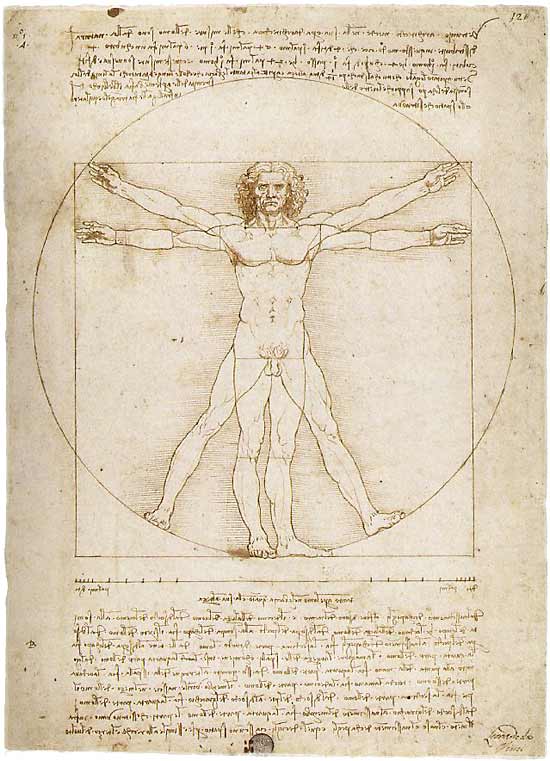
This ratio, and the aesthetically pleasing Golden Triangle derived from it, shows up in human-designed objects like the pleasant-to-the-eye, commonly accepted shapes of rectangles used to frame pictures, or the triangle-faced sides of the Great Pyramids – placed there by intentionally by their human designers. But what is more notable is that humans design such things with this ratio in mind in the deliberate attempt to mimic its appearance in the natural world in such disparate locations as the infamous mathematical Fibonacci Sequence, the spirally expanding geometry of the Chambered Nautilus shell, the similarly appealing geometry of flower petals, or in the famously “perfect” proportions of DaVinci’s Vitruvian Man.

It seems, in other words, that this mathematical concept not only keeps showing up in our natural world but that, when it does, it invokes in us a sense of pleasure that we have come to know as beauty. Notice however that the real seat of what we call beauty is not, as we have been told ad nauseam, in the subjective “eye of the beholder.” It is really an objective trait built into the object which we, as observers, are only wired to recognize – even if we can’t say why.

I wish I could claim this as some kind of powerful observation that I have just uncovered but this is not a new idea. I can’t find the source of the following for the life of me but it has been noted that …

Plato believed in the existence of absolute truth, goodness, and beauty. Beyond our fuzzy and confused view of things is the reality of eternal standards and structures. There are many (more or less) good things; there is one absolute good. There are many (more or less) beautiful things; there is one absolute beauty ... The highest idea or form -- the form of all forms -- is the idea of the Good itself. According to Plato, this idea is not an inert structure, but has power. Plato compares the power of the Good to the power of the sun. The sun illuminates things and makes them visible to the eye. The absolute good illuminates the things of the mind (forms) and makes them intelligible. The good sheds light on ideas. What exactly is the idea of the good? Plato is reluctant to say. The vision of the idea of the Good is, according to Plato, too much for human minds. It is possible that the idea of the Good is the idea of absolute order. Order is what makes beautiful things beautiful, just persons or cities just, true speeches true. (truth is the order or correct arrangement of words, putting words together that belong together).

There are areas of his philosophy where Plato diverges into wildly anti-theistic (and therefore anti-Christian) concepts – but this is not one of them. Plato lived a few hundred years before Christ so he cannot be blamed for denying Him specifically. He may well have been aware of, and influenced by, Jewish thought. But what Plato did make an effort to do was seek the truth. And, at least in this category of thinking, he seems to have found it.

Substitute God for Good in the quotation above and you find an undeniably Christian definition of Truth, Goodness, Beauty and Order as having their source in the mind of God.

If, as Galileo Galilei is reported to have said, "Mathematics is the language with which God wrote the universe," it becomes easy to see why a California plastic surgeon so easily uncovered the connection between mathematics and beauty. He is not the first to do so.

The idea that mathematics has divine origins was quantified by Leonhard Euler who, upon discovering the following “identity” labeled it as “proof that God exists.”

Though I would never be tempted to use this as some kind of practical apologetic argument, one does have to wonder why three seemingly unrelated numbers (pi, the ratio of a circle’s circumference to its diameter; i, the imaginary number and the square root of -1, and; e, the natural logarithm so prevalent in calculus, probability and limit theory) would have any such relationship to one another. These are irrational numbers, not invented by mathematicians, but discovered by them as constantly popping up in every mathematical and scientific nook and cranny they explore. Indeed, physicist Richard Feynman called Euler’s identity equation "the most remarkable formula in mathematics."

Even the renowned atheist Bertrand Russell expressed his sense of mathematical beauty in his Study of Mathematics, in Mysticism and Logic, and Other Essays with these words:

Mathematics, rightly viewed, possesses not only truth, but supreme beauty — a beauty cold and austere, like that of sculpture, without appeal to any part of our weaker nature, without the gorgeous trappings of painting or music, yet sublimely pure, and capable of a stern perfection such as only the greatest art can show. The true spirit of delight, the exaltation, the sense of being more than Man, which is the touchstone of the highest excellence, is to be found in mathematics as surely as poetry

How is it that mathematical concepts like these serve to describe the world so well? Only if beauty is really in the mind of the Encoder – an objective reality inherently built into the makeup of the universe itself.

(This is a topic for which a powerful argument has already been written. If you want to delve into it more, check out “A Meaningful World: How The Arts and Sciences Reveal the Genius of Nature.”)

This, like many other qualities of the universe, is so transparently obvious we have come to take it for granted. And this brings me to the second story that caught my eye -- a correspondence by James Emery White in which he addresses the idea that the trappings of the distracted life in which we are all so caught up is causing us to lose our ability to appreciate the inherent beauty that surrounds us in the creation.

White tells the story of a social experiment staged by essayist Gene Weingarten and The Washington Post at 7:51 a.m. on Friday, January 12, 2007 in the middle of the morning rush hour at the Washington, D.C. Metro at the L’Enfant Plaza station. There, 39-year old Joshua Bell, one of the finest classical musicians in the world, donned blue jeans, a tee-shirt and Washington Nationals baseball cap, put his $3.5 million Stradivarius violin on his shoulder and began to play some of the most elegant music ever written. You can see a short video of his performance here.

Over 1,000 people passed by Bell that morning -- key words, "passed by." Only six or seven of those who entered the Metro station where Bell was playing even offered him a passing glance. In his comments on this, White references British author John Lane, whose 2003 book, Timeless Beauty, speaks to "the loss of the appreciation of beauty in the modern world. People still have the capacity to understand beauty, he said, but beauty has become irrelevant to them."

While we have good reason to address the lack of respect for Truth and Goodness in our culture, it seems that we are less adept at understanding, or even noticing, that same culture's lack of respect for Beauty. Everything we value in this life has its basis in one of these three or their combination. Even the technological gadgetry that so easily distracts us owes its design to the mathematical order, trustworthiness and beauty of the Grand Designer's mind. We would do well to stop, look, and listen to the art, music, literature and poetry that derive from the same fundamental Source as our iPod. And we would do well to honor the beauty of this creation with all the respect, reverence, awe and honor it deserves.

Friday, June 01, 2007

The Griswolds Go To Canada

Our clan has never been camping. We always thought it would be too difficult (dangerous?) with little kids. OK, that's a lame excuse but it's the best I can come up with. So, now that our youngest has turned 10, we decided to join my wife's brother and his family for their annual Memorial Day camping extravaganza to the Pinery Provincial Park in Ontario. Beautiful place right on Lake Huron. We pulled into our site only to find that everyone surrounding us -- and I mean everyone -- was a professional camper.

Yeah, and here we were with our newly bought tent, a bunch of tarps still wrapped in their original packaging, 14 pocket knives (somehow the boys thought that packing a pocket knife, or two, would automatically transform them into "campers"), a few pots and pans, a camping stove that we had never used and ... well, you get the picture. As we unloaded our van I felt the pall of an unidentifiable doom descending onto my shoulders.

Oh wait. No, that was just rain.

We had done a practice tent set up in the backyard at home, but that trial run did NOT include the somewhat more complicated task of identifying the "perfect" spot on which the tent should rest. I won't bore you with the details but I will offer advice to those rookie campers who are less experienced than we ...
  1. Though you doubt the odds of it, it may rain every day you are there.
  2. Probably not a good idea to climb a tree to saw off a branch that is encroaching on the "perfect" spot for your tent. First, it's illegal (as your neighboring campers will soon let you know). Second, hanging parallel to the ground and sawing don't go well together. I offer as evidence denuded forearms and a bruised shoulder.
  3. As for sawing, may I suggest a sharp saw that does NOT jump out of its assigned groove to unapologetically attack your too-close-for-comfort thumb. The Frankenstein resembling gash you get from such an encounter will ache for the rest of your camping trip and bleed profusely, thereby posing the danger of attracting vermin.
  4. As for vermin, leaving the bread on the picnic table when you leave the campsite area is not a good idea. Yes, the vermin can identify food even if it is still in the "wrapper." Failure to adhere to this guideline will render you bread-less for the rest of your stay.
  5. Raccoons are bigger than you think. When you hear them rummaging around the campsite after you've called it a night, shining your flashlight in their beady little eyes will not faze them in the least. However, if your wife is looking over your shoulder as you do so, her blood-curdling scream may attract more unwanted attention than you desire.
  6. Everybody can hear everything you say from the tent next door. 'Nuf said about that.
  7. Kids DO NOT understand the concept of keeping the sand, dirt, mud and water on the OUTSIDE of the tent -- no matter their age.
  8. Though you may think you're really smart hoisting a giant tarp above your campsite to protect you from the rain (did I mention it rained all weekend?), and though you may actually think you've done well to have the tarp drain away from your tent -- if the tarp drains to a point that is uphill from your tent, the water will eventually find its way downhill to puddle at your tent's front door.
  9. Smoke follows ugly too.
  10. It will take you 8 days (or 9 showers -- whichever comes first) to get the smoke smell out of your hair.
  11. Lake Huron in May is really stinkin' cold.
There is more but I forget it all. Having said all that I must also include the good stuff ...
  1. The Great Lakes have THE BEST round, flat skipping stones on Earth.
  2. The Official World's Record for skipping a stone is 16. This includes an estimate of 6 or 7 for that part when they seemingly hover on the water with miniature skips right at the end. This record is not contestable -- even in a court of law.
  3. Your kids will never forget the skipping stones contest. They will, however, collect buckets full of those perfect skipping stones for use on small ponds around your home neighborhood. Being calm, these ponds could provide the perfect location to break the Official World's Record for skipping a stone ... stay tuned for updates.
  4. Though the water temperature on Lake Huron approaches absolute zero, you must still enter the contest to see who will be the first one to go all the way under water. It's a test of manhood -- even if your wife wins.
  5. The Official World's Largest Ant Hill is in the Pinery Provincial Park in Ontario, Canada. We almost stepped in it.
  6. On the hike when you find the Official World's Largest Ant Hill, you may not stay on the well-marked trail meant for hiking. That's boring. Climbing steep cliffs, wielding sticks as weapons, and finding the poison ivy is much more fun and memorable.
  7. It is possible for teenage (and pre-teen) boys to spend 3 days NOT surgically attached to a computer or video game but outside in the fresh air. In doing this they can also thoroughly enjoy themselves -- even if it is raining outside -- and not declare that they are bored or that there is "nothing to do."
  8. "The Camping Song" and "It's Gonna Be A Fine Day," when played from the stereo speakers of your van at 270 decibels, will cause you, and many of those around you (some of whom you have never met in your life), to dance and jump around like complete fools. This especially true when said songs are played immediately following a downpour and prior the next one starting.
Camping is the best vacation because the fun doesn't end when the trip is over! When you get home you get to set up all your tents and spread out all your tarps again to clean off the sand, and dirt, and mud, and water (on the inside AND outside of the tent). Then you get to dry them and refold/repack them all for a second time. You get to hose off all your chairs, air out all your sleeping bags and wash all your clothes (8 days or 9 times, whichever comes first) to get the smoke smell out of them.

It's the vacation that never ends -- especially if it rains every day.

Wednesday, May 16, 2007

Passing On Our Narcissism

I recently read about the results of the Narcissistic Personality Inventory (NPI) -- a nationwide survey of 16,475 college students conducted between 1982 and 2006. In a nutshell, the survey revealed that the narcissistic attitudes of our youth have risen steadily over the past 25 years. In its latest iteration, two-thirds of the students demonstrated above average narcissism -- up more that 30% since 1982.

Reading this reminded me of another survey conducted during the 1990s wherein a research group studying the state of American education released a report comparing the math scores of U.S. and Japanese high school students. The results were not surprising. The Japanese students scored significantly higher than their American counterparts on an equivalent test. But what was notable was the response to a question asked of both groups of students right after they had finished taking the test but before they had seen the results. The Japanese students overwhelmingly expressed dejection and embarrassment for what they considered to be a poor performance on the test. The American students were confident they had aced it.

On hearing the reports of this study, one well-known critic of the public school system in America remarked, “I think its safe to say we’ve done a good job of addressing any worries we might have had about our children’s self esteem.”

Where did these narcissistic tendencies originate -- and why?

Sunday, May 13, 2007

The Ironic Tyranny of Academic Intolerance

Today, the Ames (Iowa) Tribune reports that eminent astronomer Guillermo Gonzalez has been denied tenure at Iowa State University. This may seem unworthy of a news report ... unless you understand who Gonzalez is and why this is happening to him. Guillermo Gonzalez's simple shortcoming is that he has the audacity to not tote the party line along with his fellow scientists.

If that is a criterion for academic shunning, Copernicus, Einstein and Darwin should have been hog-tied, gagged and left to rot in a dungeon somewhere.

While the published criteria for receiving tenure at ISU consists:

"'primarily on evidence of scholarship in the faculty member's teaching, research/creative activities, and/or extension/professional practice' ... In addition to that, Gonzalez's department of astronomy and physics sets a benchmark for tenure candidates to author at least 15 peer-reviewed journal articles of quality."

Gonzalez has published 68 peer-reviewed articles -- 23 of those since he arrived at ISU in 2001.

No, Gonzalez's "problem" is not that he is deficient intellectually, academically or professionally. Gonzalez's "problem" is that, in the opinion of those who control the levers of power both within the scientific community in general and at ISU specifically, he doesn't think properly.